


Most $10M companies are sitting on geometric multipliers they’ve never seen.
WHAT YOU’LL UNLOCK IN THIS ISSUE
Why the strategies that got you to $10M are likely working against you
The geometric lever hiding inside most $10M+ businesses — and why it stays hidden
Three case studies: companies that broke through the $10M ceiling — and the moves each one made
Special GRATIS invitation this Thursday: my live methodology session — open to a small group of qualified leaders only
A furniture store owner was losing sleep.
Not because business was bad. Business was fine. $2.4 million a year. Solid operation. Good reputation. Loyal customers.
But growth had stalled for 18 months.
He’d tried everything logical.
More advertising
Better inventory
Seasonal promotions
New sales incentives
He worked harder every quarter and moved nowhere.
So I walked his showroom floor for three hours. Customers browsed, picked up lamps, ran their hands along fabric samples, paused at price tags. His salespeople greeted them at the door.
Every time a customer walked in, the salespeople said the same thing.
“Let me know if I can help you.”
Then they stepped back. The customer wandered. Some bought. Most didn’t.
I suggested one change. Nothing bought, built, or added.
I changed the greeting.
Instead of “let me know if I can help,” salespeople were trained to say: “I can see you’re looking at that piece. Let me show you how three of our best customers are using it in their home right now.”
Sales tripled.
Nothing changed. Same store, same staff, same customers off the same street.
3X — one question changed the conversion and the outcome.
The Question That Multiplies Performance
You hit $10M doing something right.
You got there by being better than your competition at something real. Don’t minimize that.
The same thinking that got you here — additive thinking — is now your primary obstacle.
You’re asking:
How do we get more customers?
How do we add another channel?
How do we grow the team?
You’re grinding. Because additive thinking produces additive results. 10% improvement on 10% effort. Hard-won, exhausting, incremental gains.
That’s additive thinking. And there’s another way to see it entirely.
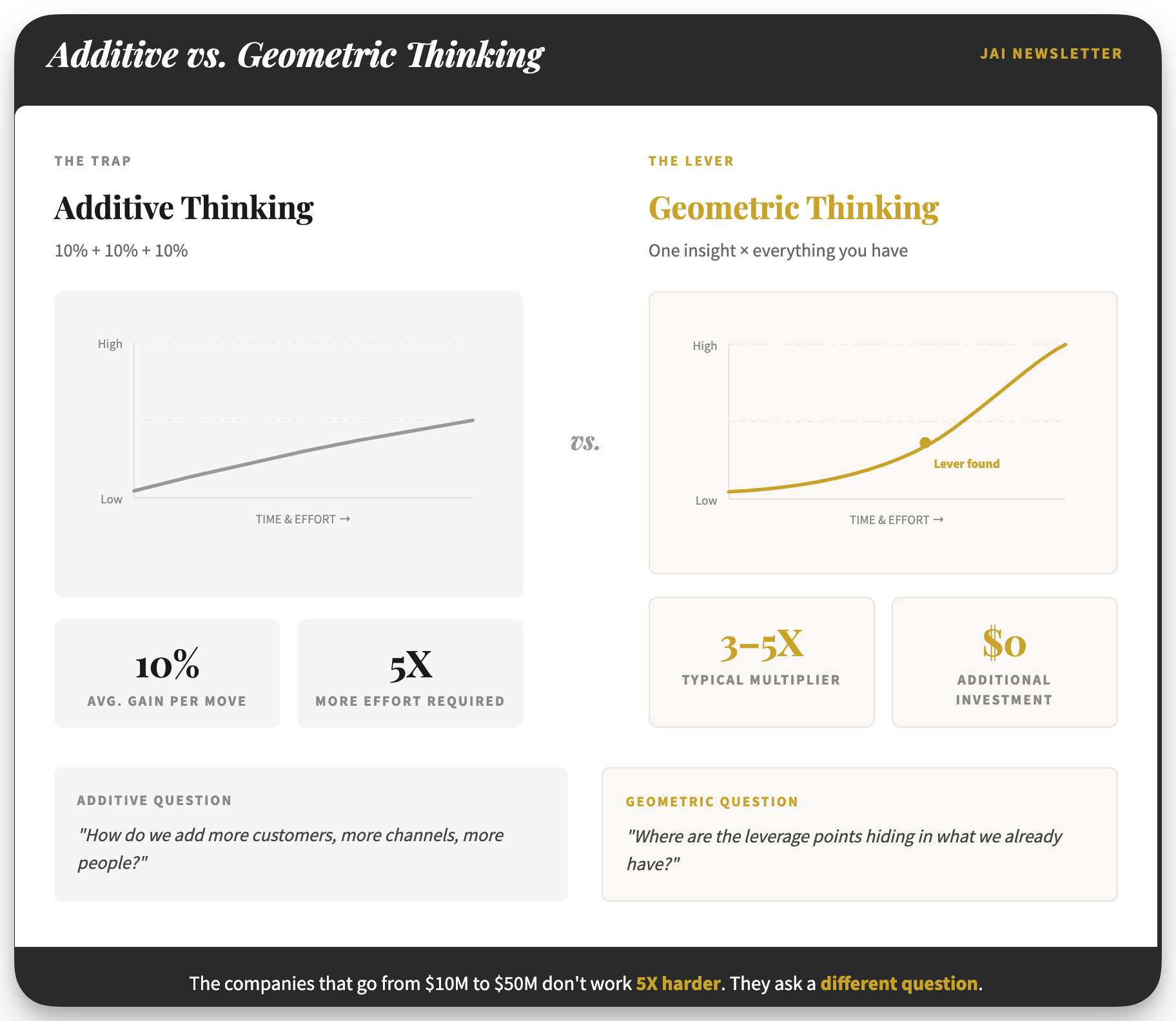
There are only three ways to grow a business. Increase your inputs. Increase your efficiency. Increase your yield.
Most companies focus almost entirely on number one. And number one is linear. Double the spend, hope to double the output. That’s proportional thinking.
Geometric thinking focuses on two and three. And here’s what makes it undeniable: improving performance across multiple points in a revenue system doesn’t add — it multiplies. Even modest improvements across several drivers create non-linear output.
This is not inspiration. It is geometry.
The companies that go from $10M to $50M don’t work 5X harder. They don’t spend 5X more. They ask a different question entirely.
“How can this same action produce 3X the result?”
They ask:
Where are the geometric leverage points hiding in what we already have?
Breakthrough thinking doesn’t add to what you have. It reframes what you already have — and the same assets, relationships, and businesses produce completely different outputs.
Three Companies That Found The Lever
Investment Rarities Inc. Revenue: $300,000.
$300,000 a year and flatlining.
Then they asked one different question. Not “how do we get more customers?” But: “who already has the trust of the exact customer we’re trying to reach?”
They identified a strategic alliance. A partner with a pre-existing audience of qualified buyers — people already primed to buy exactly what they sold.
No new product. No new advertising budget.
Revenue went from $300,000 to $500 million in two years.
The product didn’t change. Neither did the team. One geometric insight about where trust already existed — and it changed everything.
Wesley Financial Group Couldn’t Outspend Their Competition
Well-funded players dominated the space. Traditional marketing was a losing battle.
So they stopped competing for market share. They designed a category. They became the only logical choice in a space they effectively created.
They didn’t grow their share of an existing market. They made the concept of competition irrelevant.
Revenue quadrupled. They became the dominant force in timeshare cancellation.
Not by doing more of what existed. By seeing something their competitors couldn’t.
Brian Benstock Ran A Honda Dealership In New York
He restructured how he acquired inventory, redesigned the sales process, and repositioned against every other dealer in his market — simultaneously.
Each one was a geometric multiplier. All three compounding together?
He built the #1 Honda dealership in North America.
Multiple levers don’t add up. They compound. Each one amplifies the others.
Why You Can’t See Your Own Lever
You can see this instantly in someone else’s business.
If a friend described their situation over coffee, you’d spot their obvious next move in 30 seconds. You’d ask one question. They’d go quiet. Then: “I’ve never thought about it that way.”
But in your own business? You’re too close to see any of it.
Call it the curse of expertise. You’re too close to your own operation. Too fluent in your own assumptions. You’ve stopped questioning the things that feel obvious. That’s where the leverage hides.
The $10M ceiling is made of questions you stopped asking — because you assumed you already knew the answer.
The furniture store owner knew everything about furniture. He didn’t know he was solving the wrong problem.
Someone had to show him the question.
This Thursday, 2/26: A Private Invitation
I’ve spent 50+ years identifying leverage points like these.
Across more than 10,000 businesses. 1,000+ industries. $75 billion in documented results.
In almost every $10M+ company I’ve ever worked with, I find the same pattern: three to five geometric leverage points hiding in plain sight.
Not new products.
Not new hires.
Not larger budgets.
Just a different way of seeing what’s already there.
Here’s the math most leaders never run.
If a company doubles revenue but margins compress, profit may barely move. But if net margin improves from 10% to 20%, profit doubles. Without adding infrastructure or complexity.
That’s the difference between top line growth and bottom line breakthroughs.
Top line growth requires more customers, more traffic, more spend, more operational load — and often increases cost simultaneously. Bottom line breakthroughs come from pricing, margin management, retention, sequencing, positioning.
Decisions are safer than markets. And these are decisions you can make this quarter.
This Thursday, I’m running a 4-hour private working session for a select group of $10M+ company leaders.
I’ll be hands-on — four hours of real diagnostic work.
I’ll show you the exact lens shift that separates additive from geometric thinking — through real stories, not theory
We’ll map the three phases of your revenue system where leverage is hiding right now
We’ll run the math — what happens when you move multiple levers simultaneously
I’ll open the floor and work through real business applications live, in front of the group, to uncover leverage points in real time
Most leaders leave with three to five specific opportunities identified in their own company. Not just vague frameworks. Many can be deployed very quickly, often within 30-90 days, and you can apply them to every facet of your revenue system so you can achieve leverage on top of leverage.
I do this work at $250,000 for private clients.
This Thursday, it’s available to a small group of qualified leaders at no cost.
If your company is doing $10M or more — and you know you’re leaving growth on the table but can’t see where — this is the room.
Seats are limited. The session is this Thursday.
Geometric leverage points don’t disappear if you miss Thursday.
But you can’t act on what you can’t see yet.
— Jay
P.S. This session is designed for $10M+ company leaders. If you’re running a business below that threshold, the frameworks may make sense — but they won’t move the needle the same way for smaller companies. The frameworks require sufficient complexity and momentum to really work. If that’s not you yet, hold tight. We’ll have something designed for your stage soon.


